
A photograph taken in the FOX booth became a trading card before halftime. Then Tom Brady signed it on air. That sequence gives TBGS something a standard autograph checklist cannot supply: a public origin story for one specific signed card.
Brady was back in Foxborough for the November 8 Packers-Patriots broadcast. According to FOX’s account of the signing, the card was printed in the booth and handed to him during the second quarter. The photograph, the broadcast and the autograph all belong to the same afternoon.
For collectors, the attraction is unusually concrete. The signed card connects Brady’s return to the place associated with his Patriots career to the moment he helped turn that return into a collectible. But the card people could order and the card Brady signed were two different propositions. Understanding that difference is the key to collecting this release.
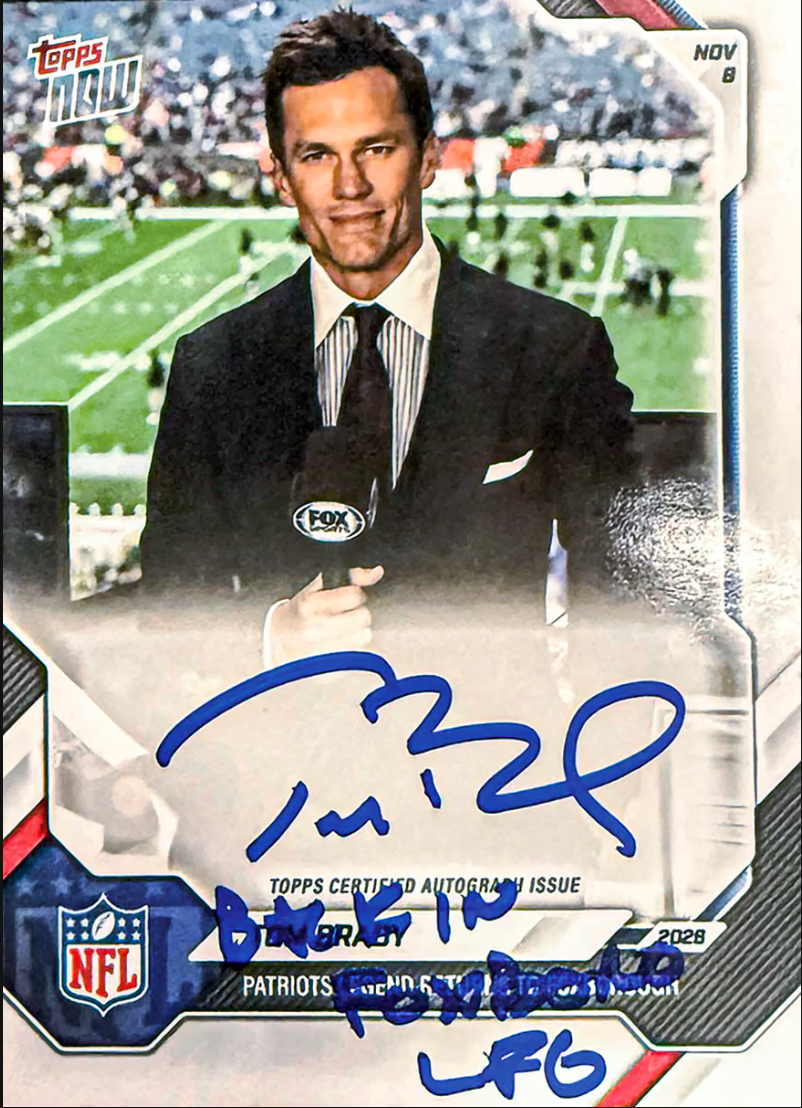

A signature with a scene attached
Sports Illustrated’s report fills in the timing: a first-quarter photograph reached Brady as a finished card in the second quarter. He added the inscription “Back in Foxboro LFG” and held it up for viewers. The report identifies the signed copy as the card intended for one collector through the release.
The photograph published by FOX shows the blue signature spreading across the lower part of the card, with the handwritten inscription below it. Those marks are part of the appeal. A collector can relate the physical object to a particular appearance and signing, rather than relying on a generic description of a Brady autograph.
That gives the ordinary card a role, too. Its unsigned image preserves the broadcast-booth portrait and the return-to-Foxborough theme without the writing across the front. A fan interested in the occasion could collect that version for the image itself. The signed version adds Brady’s participation in making the object during the event it commemorates.
The order was for TBGS, with a separate autograph chase
Topps’ TBGS listing offered an open-edition card, numbered foils and a one-of-one autograph redemption. The ordering dates were November 8 through November 11. Buying the release did not mean buying Brady’s live signature outright.
That distinction can disappear quickly when a headline leads with “Brady signs a 1/1.” The photograph of the signed object explains the chase; it does not describe every card shipped under the TBGS name. The base card, foil editions and autograph redemption each need to be identified when comparing listings.
For someone who wants the broadcast image, an ordinary TBGS copy may satisfy the collecting goal. Someone who wants the object associated with the live signing is looking for a much more specific card. Matching the subject and product number is only the start; the edition, signature and inscription matter as well.
Two different reasons to see “1/1”
The foil ladder runs through /50, /25, /10, /5 and a one-of-one FoilFractor. Separately, the listing advertises the one-of-one autograph redemption. A FoilFractor and the live-signing autograph are distinct editions, even though both can be described as one-of-one cards.
This is the practical trap in a search result or cropped marketplace photograph. A seller might accurately identify a TBGS 1/1 while showing the foil edition rather than the signed object from the broadcast. The useful question is which edition is pictured. The autograph story belongs to the signature and its documented origin, not to every use of the serial designation.
The advertised foil denominators add to 91 cards; the separate autograph redemption brings that listed numbered inventory to 92 before any conditional Chrome additions. That comparison describes the product’s editions. It is not the total TBGS print run or an order’s chance of receiving the autograph.
What to preserve with a provenance card
If this card is the goal, the supporting material deserves a place beside the card. Keep the manufacturer’s product description, the broadcaster’s signing report and clear photographs of the front and back together. Each answers a different question: what was offered, what happened on air and what physical card is being presented later.
For a redemption transaction, distinguish the redemption card from the fulfilled signed card. A photograph of one establishes a different stage of ownership from a photograph of the other. Before comparing two asking prices, establish that they describe the same stage and edition. Otherwise, a seemingly simple price comparison can involve different objects.
The broadcast is a strong starting point for provenance. A later buyer would still want the ownership and fulfillment records connecting the offered card to that origin. A clip can document a signing; the documents accompanying a particular sale explain how that particular object reached its seller.
After the ordering window
As of November 13, Topps’ football archive lists TBGS as sold out. A final print run and the identity of the eventual autograph recipient remain unconfirmed.
That leaves two sensible ways to follow TBGS. A collector building a Brady timeline can treat the base card as the record of his return to the booth in Foxborough. A collector pursuing the signed card can follow the redemption and eventual ownership history, keeping the broadcast photograph as the visual reference.
The lasting reason to remember this release is the speed and specificity of its creation. Brady did not merely appear on a card celebrating an earlier achievement. During the game, he became part of the card’s production story. The ordinary TBGS lets collectors keep the moment; the signed copy carries the marks he added to it.
Source note
Signing coverage and signed-card photograph: FOX Sports, courtesy of Topps. Additional timing and inscription reporting: Sports Illustrated. Product editions and ordering dates: Topps. Source and result checks completed November 13, 2026, after 8 p.m. CST.