
It depends what you want the card to do.
If you want a keepsake from a game you attended, the base card may give you everything you hoped for. If you want an autograph, the same purchase is a chance at a different prize. If you want to sell later, you need a buyer willing to pay enough to cover your costs.
Those are three meanings of value: personal value, chase value, and resale value. A card can serve one goal well without serving the others.
Think of three fans looking at the same release. One wants a card for a team binder. One orders extra copies in hopes of a numbered foil. One plans to list the cards for sale. They share a checkout page, but they should not share the same test for a good purchase.
The binder collector can ask whether the card is worth the price to them. The chase buyer needs to know which special cards are available and how the chance works. The resale buyer needs matching completed sales and a clear view of costs.
New to the program? Start with What Is Topps NOW? Cards, Print Runs, and Parallels. It explains how a release goes from a short buying window to a published print run. Here, the question is what you get from owning it.
What do you want the card to do?
Choose the reason that carries your purchase.
Memory
I want the player, team, game, or image.
Check: Is the full price worth owning it?
Read about personal valueChase
I want a foil, autograph, relic, or variation.
Check: What can arrive, and how does the chance work?
Read about chase valueResale
I want to sell the card later.
Check: Do matching sales support my costs?
Read about resale valueView accessible data
| Goal | Desired outcome | Question before buying |
|---|---|---|
| Memory | I want the player, team, game, or image. | Is the full price worth owning it? |
| Chase | I want a foil, autograph, relic, or variation. | What can arrive, and how does the chance work? |
| Resale | I want to sell the card later. | Do matching sales support my costs? |
Personal value is a complete reason to collect
Imagine keeping a card from your child's first game. Or the night your team won a title. Or a player's debut that you watched with a friend. These are examples of why someone might collect, and none requires a later buyer.
The value is in having a small, lasting reminder of something you care about. The card might sit on a desk, fill a space in a binder, or become a gift. It does not have to rise in price to do that job.
That fits the basic idea behind Topps NOW's moment-focused releases. The player, team, game, or image can be the whole reason to own the card. A foil can be a welcome surprise without being the test of whether the purchase worked.
Price still matters. Personal value is not a reason to ignore your budget. It is a reason to use the right question: would you be happy to own this card at the total price, even if you never sold it?
If the answer is yes, you have a clear collecting goal. You do not need to defend it with a forecast. A card bought for a memory can remain a good purchase after its resale price falls, just as a higher asking price cannot make you care about a player you do not follow.
Personal value also helps decide how many copies to buy. One may fill the space in your collection. A second might be a gift. Beyond that, ask what the extra copies are for. If the answer becomes “a better chance at a hit,” you have added another goal, with another cost.
There is nothing wrong with wanting both the card and the chase. Keep them visible as separate reasons. That makes it easier to choose an amount you will still feel good about when the package arrives.
Chase value starts with the hit you actually want
Chase value is the appeal of a possible special card. That could be a numbered foil, autograph, relic, image variation, or another listed hit. The first step is to name your target.
Would any foil make you happy? Are you seeking a signature? Would only a 1/1 count? Those buyers can read the same product page and reach different decisions. More cards in a tier you do not want may do little for your own collecting goal.
PrintRun's How Topps NOW Hit Structures Changed, 2016 to 2026 explains why the available tiers differ. Its companion, Same Price, Different Chase: How to Evaluate Topps NOW Before Buying, shows how the target, price, and print run change the comparison. Use those studies for the detailed structure and chase analysis.
For a purchase decision, focus on the exact release. Check the listed hits, their known quantities, your order size, and your full checkout cost. If the final print run is not known yet, treat it as unknown. If an image variation has no published quantity, its picture cannot tell you how many exist.
The details also affect what arrives. Topps says a non-base hit may replace a base card. It ties the opportunity to the quantity of cards ordered, rather than the number of separate orders. Do not assume that splitting an order creates extra chances, or that every special card comes on top of all the bases.
Our guides to parallel odds, Chrome unlocks, and image variations and short prints explain those parts of the offer.
A valuable prize and favorable odds are separate questions. A rare card can sell for a large sum while remaining hard to receive. Its sale price alone tells you neither the chance of getting it nor whether an order will pay for itself.
You can still enjoy the chase. Set a spending limit that does not depend on a hit arriving. Decide what you will do with the base cards if that is what you receive. That gives the opening its own place in your hobby budget.
Topps NOW hits that sold big
Premium Topps NOW cards have real market value. Cooper Flagg is a useful example: Topps has reported large sales of both a scarce draft autograph and a numbered card from his NBA debut. Basketball and baseball provide a longer history, too.
The dates below put those examples in order. Some amounts come from an auction result; others are explicitly reported by Topps or a sales-history service. A reported amount is identified as such. These are selected examples, not average outcomes. Valuable premium cards do not mean that the average order makes a profit.
Topps NOW hits that sold big
Selected sales and reported results across 2024 and 2025. These are examples, not average outcomes.
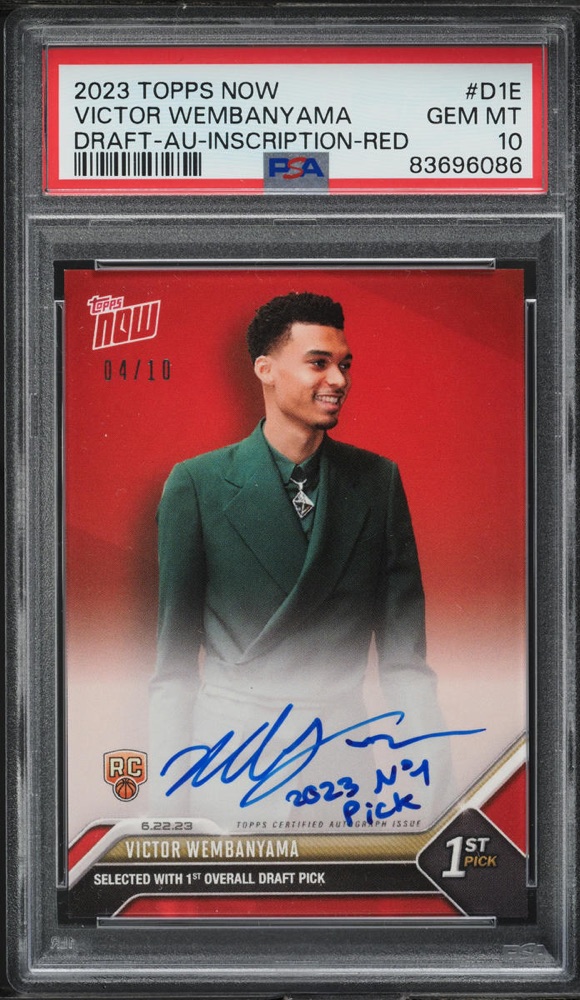
Card image: Fanatics Collect auction June 21, 2024Victor Wembanyama · 2023 Topps NOW Draft #D1E · Red Inscription Autograph /10
US $22,200PSA 10 · Independently verified auction result · Auction total including buyer's premium
Topps reports $22,000 in 2024. Its linked auction states $22,200 including buyer's premium. Signed versions were originally sold through a Dutch auction. The 72,171-copy base print run does not establish autograph odds.
- May 4, 2025 · Year from the May 2025 story
Paul Skenes · 2024 MLB Topps NOW Rookie of the Year autograph /5
Topps reports US $1,750Grade not stated · Topps-reported · Fees not stated
The original transaction behind this Topps report was not independently checked here. This is the Rookie of the Year release, separate from his Topps Chrome debut patch card.
- August 30, 2025 · Year from the October 2025 story
Cooper Flagg · 2025 Topps NOW draft Red Refractor autograph /5
Topps reports US $16,000Grade not stated · Topps-reported · Fees not stated
Edition name used by Topps. The original transaction behind this Topps report was not independently checked here.
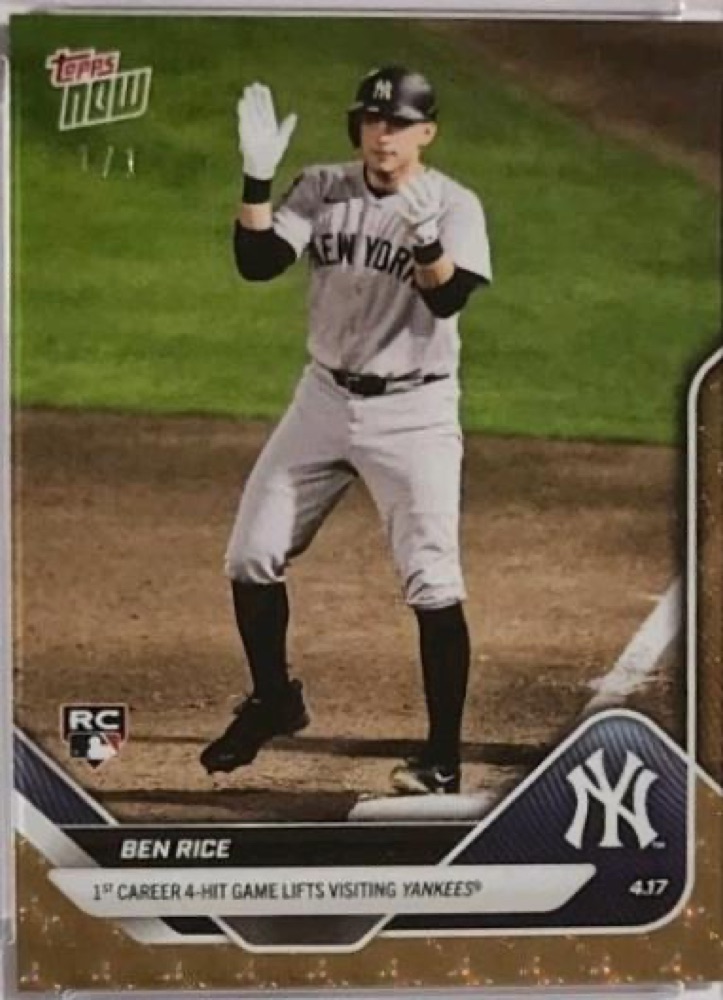
Card image: SportsCardsPro October 1, 2025Ben Rice · 2025 Topps NOW #77 · FoilFractor 1/1
SportsCardsPro reports US $1,350PSA 9 · Reported eBay sale · Format, shipping and fees not stated
A secondary sales-history report; the underlying eBay transaction was not independently checked here.
- December 2025 · Day not stated
Cooper Flagg · 2025-26 NBA Topps NOW #6 debut FoilFractor 1/1
Topps reports US $21,960Grade not stated · Topps-reported · Fees not stated
The original transaction behind this Topps report was not independently checked here. A foil sale, distinct from the draft autograph.
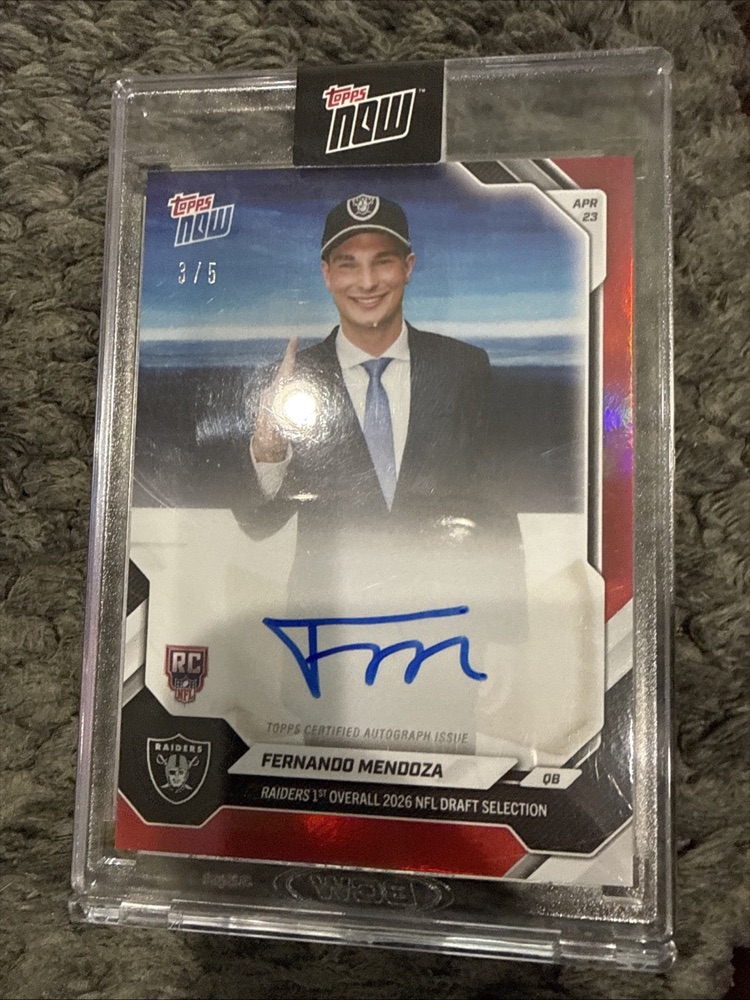
Fernando Mendoza · 2026 NFL Topps NOW Draft autograph /5
Completed sale, final price not publicUngraded · Excellent, as listed
Sold July 3; year not shown
The saved eBay view shows a US $14,000 asking price and Best Offer accepted. The ask is not the accepted amount.
View accessible data
| Card | Sale date and precision | Amount | Price basis | Grade | Source | Purchase context |
|---|---|---|---|---|---|---|
| Victor Wembanyama · 2023 Topps NOW Draft #D1E · Red Inscription Autograph /10 | June 21, 2024 | US $22,200 | Independently verified auction result · Auction total including buyer's premium | PSA 10 | Read Topps’ coverage · View Fanatics Collect result | Topps reports $22,000 in 2024. Its linked auction states $22,200 including buyer's premium. Signed versions were originally sold through a Dutch auction. The 72,171-copy base print run does not establish autograph odds. |
| Paul Skenes · 2024 MLB Topps NOW Rookie of the Year autograph /5 | May 4, 2025 · Year from the May 2025 story | Topps reports US $1,750 | Topps-reported · Fees not stated | Grade not stated | Read Topps’ Skenes guide | The original transaction behind this Topps report was not independently checked here. This is the Rookie of the Year release, separate from his Topps Chrome debut patch card. |
| Cooper Flagg · 2025 Topps NOW draft Red Refractor autograph /5 | August 30, 2025 · Year from the October 2025 story | Topps reports US $16,000 | Topps-reported · Fees not stated | Grade not stated | Read Topps’ Flagg guide | Edition name used by Topps. The original transaction behind this Topps report was not independently checked here. |
| Ben Rice · 2025 Topps NOW #77 · FoilFractor 1/1 | October 1, 2025 | SportsCardsPro reports US $1,350 | Reported eBay sale · Format, shipping and fees not stated | PSA 9 | View the sales-history record | A secondary sales-history report; the underlying eBay transaction was not independently checked here. |
| Cooper Flagg · 2025-26 NBA Topps NOW #6 debut FoilFractor 1/1 | December 2025 · Day not stated | Topps reports US $21,960 | Topps-reported · Fees not stated | Grade not stated | Read Topps’ rookie-season coverage | The original transaction behind this Topps report was not independently checked here. A foil sale, distinct from the draft autograph. |
| Fernando Mendoza · 2026 NFL Topps NOW Draft autograph /5 | Sold July 3; year not shown | Final price not public | Completed sale with private final price · Best Offer accepted | Ungraded · Excellent, as listed | View the sold eBay item | The saved eBay view shows a US $14,000 asking price and Best Offer accepted. The ask is not the accepted amount. |
Topps itself makes premium sales visible in its collecting stories. Its Flagg season review also links readers to NBA Topps NOW products. That shows how real resale stories sit alongside the current chase. Enjoy the upside for what it is, while judging an order by its own terms, cost, and possible outcomes.
What base-card resale examples actually show
For resale, the useful question gets narrower: what has this version of this card sold for?
The following are five individual eBay observations. They are examples, not a picture of the whole market. We could read the displayed prices and sold information, but could not independently confirm payment or delivery. Each fixed-price entry describes one completed listing, not a count of every unit sold through it. The three presales at the end show a month and day without a sale year.
| Ungraded base card | Displayed item price and shipping | Sold information shown |
|---|---|---|
| Shohei Ohtani, 2026 MLB #428, 300th home run | US $11.43 plus $1.37 shipping | Fixed-price listing; August 16, 2026 |
| Reese Atwood, 2026 AUSL #56, Rookie of the Year | US $2.18; free shipping | Auction; September 5, 2026 |
| 2026 Disney Moana Live Action, ordinary edition | US $10.95; free shipping | Fixed-price presale; July 16, year not shown |
| 2026 Disney Toy Story 5 Poster, ordinary edition | US $5.75 plus $1.00 shipping | Fixed-price presale; June 25, year not shown |
| Lewis Hamilton, 2026 Formula 1 #38 | AU $19.95; shipping not established | Fixed-price presale; July 13, year not shown |
Atwood offers one clear comparison with a direct Topps price. The official product archive shows $8.99 for a single card and a print run of 1,838. The $2.18 auction price is below that archived price. It does not tell us what the seller paid or how much the seller gained or lost.
For a fan seeking Atwood's card, that lower sale price could be useful context for shopping. For someone planning to resell, it is a reason to check comparable sales before buying. For someone who already owns the card as a keepsake, it does not erase what the card means.
The other entries help show why matching details matters. The Hamilton price is in Australian dollars. The Disney cards belong to entertainment releases. The Ohtani listing concerns a specific milestone. Combining their prices into one average would not answer what your card is worth.
A low completed price can also reflect when supply arrives. Many sellers may receive the same base card at roughly the same time. Some may want a quick sale, need storage space, or prefer to move on from extra copies. When several sellers compete for the next buyer, they may cut their asking prices. Buyers then have lower offers to choose from, which can push completed prices down too.
That explains how a crowded market can create price pressure. It does not measure how often this happens or prove that a card has permanently lost value. These five examples do not follow the same cards over time, so they cannot show which sales were caused by crowded supply. Player demand, the moment, condition, and timing still matter.
For a collector who wants the base, that competition can create a useful buying opportunity. For a seller, it is a reason to think about how many other copies may be offered when yours arrives.
Different kinds of value can sit in one collection
Illustrative examples, not average outcomes or a price ranking.
Your card from a game you remember
No resale price neededHypothetical collecting example.
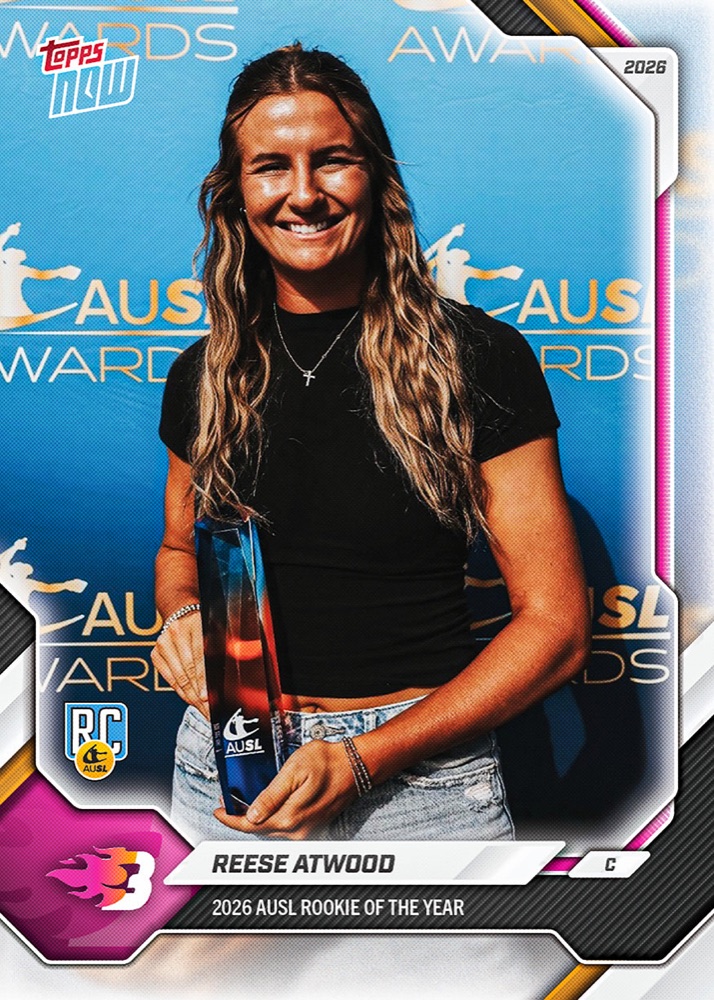
Reese Atwood · 2026 AUSL #56
Rookie of the Year · Ungraded
US $2.18September 5, 2026
Free shipping shown. Displayed auction result; payment and delivery not independently confirmed.
Ben Rice · 2025 Topps NOW #77
FoilFractor 1/1 · PSA 9
SportsCardsPro reports US $1,350October 1, 2025
Sale format, shipping, and fees not established.
View accessible data
| Example | Version | Amount and currency | Date | Source type | Price limits |
|---|---|---|---|---|---|
| Your card from a game you remember | Personal meaning | Not applicable | Not applicable | Hypothetical collecting example | No resale price needed |
| Reese Atwood · 2026 AUSL #56 | Known base · Rookie of the Year · Ungraded | US $2.18 | September 5, 2026 | eBay auction | Free shipping shown. Displayed auction result; payment and delivery not independently confirmed. |
| Ben Rice · 2025 Topps NOW #77 | Reported premium sale · FoilFractor 1/1 · PSA 9 | SportsCardsPro reports US $1,350 | October 1, 2025 | SportsCardsPro reports an eBay sale | Sale format, shipping, and fees not established. |
Resale value needs a buyer and a cost calculation
A resale plan starts with the exact card. Match the year, program, card number, edition, and condition. If it is graded, match the grading company and grade. If it is numbered, match the tier. A PSA 10 autograph /10 is not a useful price for an ungraded base just because both show the same player.
Then check whether the price comes from a completed sale. An active asking price tells you what a seller wants. A quantity-sold counter does not prove that every copy sold at the price displayed today. An auction total that includes buyer's premium is not the amount the seller takes home.
Look at the date as well. A past result can help you judge an offer, but it is not a standing bid for your copy. Ask how closely the sale matches the card you own and whether there is enough recent activity to support your plan.
Print run adds context. It tells you something about supply, not a complete story about demand. A small population does not create a willing buyer by itself. Our guide to what a low Topps NOW print run means explains that distinction. The card archive is a place to check releases and official totals.
Next, write down your costs. Include the card's purchase price, any buying costs, marketplace fees, postage, packaging, and grading if used. Shipping collected from the buyer is money coming in, but postage is money going out. Keep both visible.
The key rule is simple: gross sale price is not profit. Subtract all purchase and selling costs before deciding whether a sale meets your goal. Do not use someone else's headline auction total as money you can expect to keep.
Time matters too. Consider how long you can wait for fulfillment and a buyer, where you will store the cards, and how you will handle a return or condition dispute. A planned sale needs room for those practical issues.
If you would enjoy keeping the card, that gives you another reason to buy it. If you need a profitable sale for the purchase to make sense, require stronger price support before spending.
A known base card can be a useful resale product
There is a straightforward model for selling bases after the chase has been removed. A seller offers a known base card, makes that clear, and sets a price for that card alone. The buyer is choosing the pictured collectible without paying for an uncertain special version.
For example, a listing could plainly say that it is base only and includes no chance at a parallel or autograph. That is a hypothetical offer, but it shows the useful distinction. The buyer can judge the player, condition, delivered price, and expected shipping time without guessing what else might arrive.
A seller may price that base below the original direct offer because the chase is no longer part of the purchase. The price could also reflect convenience, combined shipping, or having the card ready to send. None of those possibilities proves that a particular seller makes a profit.
This can suit the collector whose only goal is the moment. Once you know you want the base, it is reasonable to compare a clear base-only offer with the original direct route. Check the total cost and what is included in each.
It also changes how a low resale price should be read. The original offer and the known base may contain different opportunities. Comparing the two prices does not, by itself, measure the value of the removed chase.
For the practical tradeoffs, see Should You Buy Topps NOW From Topps or Wait for eBay?.
Check what comes with the card
A known base and a seller-assigned chance are different offers.
Direct Topps offer
The exact release and its stated terms
A listed hit may replace a base
Check the product page
Transparent base resale
Known base card; chase removed
The described base card
Check condition and delivered price
Single-card chance resale
Seller’s stated chance and assignment rule
Which buyer receives a hit?
Check the rule and proof before paying extra
If assignment cannot be verified, do not assume this matches a direct order.
Unopened multi-card lot
Buying the claimed unopened lot is different from having a seller assign hits among separate buyers. Check the seal claim and included contents.
Questions to check
- What rule assigns a hit?
- Was it fixed before the contents were known?
- What record proves it was followed?
View accessible data
| Offer | Promised product | Who must explain the chance | Buyer check |
|---|---|---|---|
| Direct Topps offer | A listed hit may replace a base | Topps: the exact release and its stated terms | Check the product page |
| Transparent base resale | Known base card; chase removed | No chase in this conceptual base-only offer | Check condition and delivered price |
| Single-card chance resale | Seller’s stated chance and assignment rule | Which buyer receives a hit? | Check the rule and proof before paying extra |
| Unopened multi-card lot | The claimed unopened lot | Different from seller assignment among separate buyers | Check the seal claim and included contents |
Be careful when a single-card listing sells a “chance”
A single-card resale listing that advertises a chance at a hit raises another question: who gets the hit, and how can the buyer check?
In a saved Kenneth Walker listing, the seller states, “You will receive a base card and all hits will be extra.” The saved description advertises a chance but gives no checkable method for assigning hits to buyers. That finding applies to the saved description; it does not establish how the seller actually sent the cards.
The issue is the connection between your purchase and a physical card. If a seller distributes an order among several buyers, what rule decides who receives any hit? Was the rule fixed before the contents were known? What record lets you verify that it was followed? A promise that a hit is possible does not answer those questions.
Price deserves attention as well. A saved LeBron James #OS03 chance listing displayed US $20.00 plus $2.11 shipping. The Topps archive shows a direct item price of $11.99. These are historical displayed prices, not proof of what a buyer paid or that Topps was still taking orders at the same time.
eBay's saved chance-listings policy says, “Listings that offer an opportunity to win an item by chance or contest aren't allowed on eBay.” It also sets conditions for identical bonuses, approved breaks and repacks, and mystery products. A scarce-hit promise raises a policy question, but these listings alone do not establish seller approval status or an eBay enforcement decision.
Unopened multi-card lots are a different case. A saved Roki Sasaki offer describes five unopened cards together. That differs from a seller assigning individual cards or hits among separate buyers. The buyer still needs to check the unopened claim and what the lot includes.
Before paying extra for a single-card chance, look for a clear assignment rule and a way to verify it. If you cannot establish those, do not assume the offer gives you the same chance as buying directly under Topps' terms. A clearly described base offer remains a separate, simpler choice.
Choose your path: memory, chase, or resale
You can care about more than one path. Just be clear about which one carries the purchase. Browse the PrintRun card archive, use the guides to fill in the mechanics, and decide what would make this particular card worth owning.
Choose the test before you buy
What carries this purchase?
- Path 1
Memory
Would I enjoy owning the card at the full price?
If yesChoose the copy and quantity that fit your collection.
If noWait, compare offers, or pass.
- Path 2
Chase
Do I understand the offer and accept receiving only bases?
If yesSet a budget and compare the hit you want.
If noRead the terms before ordering.
- Path 3
Resale
Do matching completed sales support all my costs?
If yesSet a price limit and allow time to sell.
If noWait for better support or pass.
View accessible data
| Main goal | Question | If yes | If no |
|---|---|---|---|
| Memory | Would I enjoy owning the card at the full price? | Choose the copy and quantity that fit your collection. | Wait, compare offers, or pass. |
| Chase | Do I understand the offer and accept receiving only bases? | Set a budget and compare the hit you want. | Read the terms before ordering. |
| Resale | Do matching completed sales support all my costs? | Set a price limit and allow time to sell. | Wait for better support or pass. |