
The short read: Scarcity is often created before certainty. Jaxson Dart had a 307-copy college release. Ashton Jeanty had one at 940. Ty Simpson and Jordyn Tyson had releases below 500 before their first-round selections. Later cards drew far more orders. The official release comparisons show the size of those gaps.
There is more to the story than rising numbers. Fernando Mendoza's early runs fell before much larger late peaks. One numbered Omar Cooper Jr. card has traceable sale reports before and after his draft. Cheap base-card sales still appear among these same players. The Mendoza sequence and Cooper sale history show why each claim needs its own evidence.
This is a history of buying windows, fixed supply, and changing football stories. It is not a list of players to buy. “Everyone missed” describes the feeling of finding a small old release after the spotlight grows. It is not literal. Orders existed, and we do not know who placed them. The useful question is what the records can teach us before the next window closes.
The card existed before everyone cared
Start with a number small enough to picture: 307. That is the official print run for Jaxson Dart's 2024 Bowman U NOW #32. The card appeared on October 29, 2024. His selection by the Giants came the following April. The two facts belong to different points in his story. The card did not wait for the second one. Giants draft report.
Dart was not the only player with that kind of gap. Jeanty's 2024 #48 closed at 940. His 2025 draft card reached 11,798. Simpson's 2025-26 #10 reached 488, while his draft release reached 12,406. Tyson's college #32 reached 473, followed by 4,539 for his draft card. Each pair contains a smaller college release and a larger later release.
The differences are large. Jeanty's later run was about 12.6 times the earlier one. Simpson's was 25.4 times as large. Tyson's was 9.6 times as large. Those are simple divisions of the official totals. They describe production tied to different offers. They do not tell us how many people became fans or bought an old card.
Dart's later comparison needs special care. The Topps football archive records 20,589 for his September 2026 NFL #16. That is about 67.1 times the college #32 run. It is not his draft card or his first-start card. His first NFL start happened on September 28, 2025, nearly a year earlier. Moving the later card into 2025 would make the story cleaner and wrong.
This is where the central idea becomes useful. A buying window can end while the player's future remains open. A later event can give that player a wider public stage. The early release then sits behind a fixed order total. The newer release can draw many more orders without adding copies to the earlier offer.
The evidence establishes that sequence. Our interpretation is that the gap deserves attention from collectors. It does not establish a missed profit for everyone who passed. A collector could notice the player early and still choose another card. A school fan could buy one copy without caring about the draft. A large order could come from one buyer. The print run cannot separate those choices.
Across the five pairs below, the recurring fact is narrower and stronger than a promise. Small college releases existed before larger later releases. The next step is to ask how those small supplies formed.
Small college runs. Much larger later releases.
Five selected comparisons. Later cards attracted more orders; earlier resale demand was not measured.
Jaxson Dart
67.1×later / earlierFernando Mendoza
72.2×later / earlierView accessible data
| Player | College release | College PR | Later release | Later PR | Ratio | Sources |
|---|---|---|---|---|---|---|
| Jaxson Dart | 2024 #32 | 307 | 2026 #16 (Sep. 2026 pro) | 20,589 | 67.1× | Topps · Later Topps |
| Ashton Jeanty | 2024 #48 | 940 | 2025 #D-2 (draft) | 11,798 | 12.6× | Topps · Later Topps |
| Ty Simpson | 2025-26 #10 | 488 | 2026 #TSIM (draft) | 12,406 | 25.4× | Topps · Later Topps |
| Jordyn Tyson | 2025-26 #32 | 473 | 2026 #JTYS (draft) | 4,539 | 9.6× | Topps · Later Topps |
| Fernando Mendoza | 2025-26 #33 | 1,753 | 2026 #FMEN (draft) | 126,581 | 72.2× | Topps · Later Topps |
What Bowman U NOW is and how the window works
Bowman U NOW is Topps' on-demand program for college moments. It is related to professional Topps NOW, but it has its own subjects and releases. An official offer names the card and opens ordering for a limited period. Topps publishes the print run after the window ends. Jeanty's archived offer explains the process. The PrintRun beginner guide covers the wider on-demand model.
That timing creates an unusual choice. Buyers can know the moment, the subject, and the announced chase. They may not know the final order total while deciding. A print run of 488 is a historical result. It is not proof that Simpson's buyers saw that number at checkout. The same limit applies to every later claim about a tiny release.
Keep the release date and closing date apart. Tyson #32 became available on October 20, 2025. Its official page gives October 23 as the close. His April 23, 2026 selection came 182 calendar days later. That gap is supported by both dates. Topps offer, Saints selection report. Many older pages lack an exact close date. We leave those gaps unknown.
The print run also needs a careful label. Here it means Topps' reported release total. It does not mean unique buyers. Nor do we assume it always equals the physical number of ordinary base cards. Some offers add special cards to base orders. Others replace base cards with special versions. The difference affects what an order contains.
For example, Dart #32 lists added parallels. His #37 lists replacement terms and autograph redemptions. Both carry his name. They are still different offers. A base card, a numbered foil, an autograph, and a card containing memorabilia should not share one resale price simply because the player matches.
A numbered tier is a stated limit for that version. A /50 tier contains fifty numbered cards. A /5 tier contains five. A 1/1 is one card. Those limits do not reveal how many people want each version. They also do not mean that buying fifty ordinary units delivers one /50. Allocation terms and the total orders matter.
This is why the closed window is the starting point, not the whole case. It tells us when the direct offer stopped taking orders. The card can still change hands later. New releases can appear. A player's future can improve or worsen. The small old release remains one specific collectible among all those choices.
The local-to-pro attention gap
Think of attention in four stages: local, prospect, draft, and pro. These are a reading guide, not measured groups of buyers. A player can occupy several stages at once. Some players never reach all four. The point is to separate the people who might notice a college moment from those who might notice a later NFL event.
Local attention can be intense. A school fan may remember the game without needing a draft projection. A prospect follower may care about traits and future roles. Draft attention adds a clear event, a team, and a selection number. Pro attention can add starts, results, and new reasons to follow. None of those possible audiences has been counted in this study.
The idea fits the timing in the records. Dart and Jeanty had college releases months before their 2025 selections. Simpson and Tyson had theirs before the 2026 draft. These are dated facts. The suggestion that later stages can widen the audience is an inference. We do not have buyer identities or a survey proving who arrived at each step. Dart, Jeanty, Simpson, Tyson.
A larger later print run is consistent with wider interest in that offer. It can also reflect other differences. The price may change. The photograph may matter. An autograph chase may attract larger orders. A draft card may appeal to a different kind of collector. More orders alone cannot tell us which cause mattered most.
That distinction matters when people describe an old card as overlooked. A small run proves relatively few units were ordered. It cannot prove that nobody understood the player's talent. Collectors may have preferred another product. Some may have liked the player but disliked the card. Others may have waited for a professional uniform or another moment.
The research question is therefore specific: did an early offer close before a later, documented event? If it did, how small was that release? What else was available? What later sales can actually be found for that exact card? Each question adds evidence. None requires pretending that we can read the minds of the original buyers.
There is also a practical time problem. Waiting can improve knowledge about the player. It can remove the chance to order the earlier release directly. That tradeoff exists even when prices never rise. More certainty and access to the original window are not always available together. Dart's sequence gives us a concrete place to see it.
The buying window can close on the lower steps.
A way to think about widening attention, not a measured funnel or a required career path.
- Stage 1
Local
School and conference fans
Look forA dated college moment and its card
National interest may never follow.
- Stage 2
Prospect
Scouts and dedicated collectors
Look forStarting role and credible draft coverage
Projections can change.
- Stage 3
Draft
A wider football audience
Look forA confirmed selection and a draft release
A draft pick does not prove resale demand.
- Stage 4
Pro
Team fans and new collectors
Look forPlaying time, performance and exact-card sales
Attention can fade or shift to newer cards.
View accessible data
| Stage | Who may notice | Evidence to seek | What remains uncertain |
|---|---|---|---|
| Local | School and conference fans | A dated college moment and its card | National interest may never follow. |
| Prospect | Scouts and dedicated collectors | Starting role and credible draft coverage | Projections can change. |
| Draft | A wider football audience | A confirmed selection and a draft release | A draft pick does not prove resale demand. |
| Pro | Team fans and new collectors | Playing time, performance and exact-card sales | Attention can fade or shift to newer cards. |
Jaxson Dart: five small college releases
Dart's verified 2024 sequence begins with #10 at 690 and #16 at 985. Then comes #32 at 307, followed by #37 at 523 and #40 at 339. Every one is below 1,000. Two are below 500. The sequence runs from September 10 through November 12, 2024.
The order of those totals matters. They do not climb steadily. The second release is larger than the first. The third is much smaller. The fourth rises and the fifth falls again. It would be a mistake to read each change as a vote on Dart's ability. Each card is a separate moment with a separate offer.
His next major event in this account is clear. On April 24, 2025, the Giants selected him at No. 25. That gave the story an NFL team and a first-round result. It did not change the recorded runs of his college cards. It also did not make all five equally scarce or equally desirable.
The distinction between #32 and #37 shows why card identity matters. The 307-run #32 has a stated 90-card foil ladder. The 523-run #37 also lists six autograph redemptions across /5 and 1/1. It uses replacement wording. A collector seeking a signature was considering a different chase from the ordinary foil offer. #32 terms, #37 terms.
We can follow the football timeline beyond the draft. Dart made his first NFL start in September 2025. The larger card used in our comparison arrived in September 2026. Its 20,589 print run is a later pro reference. It cannot isolate the effect of draft night, the first start, or any single performance. Topps archive.
Resale records add a less tidy detail. SportsCardsPro reports a raw base #10 sale at $1.79 on August 30, 2026. It also reports a PSA 10 Blue #10, serial 5/49, at $100 on July 24. The raw base and graded foil are different objects. Neither price can stand in for the other. These are secondary sale reports, without independent proof of payment or returns. Dart sale history.
The $100 report should not be compared with a $7 Blue sale as one card's gain. That earlier report names serial 24/49 and an ungraded card. The serial and grade differ. Pairing them would hide two important changes behind a single price line. Reported Blue sales.
Dart supplies strong evidence for early scarcity and later larger releases. He supplies much weaker evidence for a simple profit story. That makes him a useful historical anchor. We can learn from his timing without turning him into a template for another quarterback.
Ashton Jeanty: college fame did not mean a giant print run
Jeanty's verified cards tell a different version of the story. His sequence contains nine numbered college releases. It starts here with #20 at 1,446, then #22 at 1,991 and #24 at 1,874. Later come #34 at 1,990, #38 at 1,042, and #43 at 1,414. None reaches 2,000.
The last three are #48 at 940, #50 at 1,424, and #53 at 1,751. The 940-copy release came on November 26, 2024. It is the smallest confirmed Jeanty release in this group. That statement deliberately stays within the cards we could verify.
You may have seen a 544-copy figure for his #5. We do not use it in the comparisons. The nominal Topps address for that card returned conflicting product details during review. Its title identified Riley Leonard and Jeremiyah Love #6, with a different print run. The address alone cannot settle which card the page describes. The reported 544 remains disputed.
Leaving that number out does not break Jeanty's case. The 940 and 1,042 totals already show modest college order volumes. The Raiders then selected him sixth overall on April 24, 2025. His draft release D-2 reached 11,798. We can document the difference without borrowing the smallest unconfirmed number.
This is the useful contrast with Dart. Jeanty's story does not require treating him as an unknown football player. The Raiders' draft report describes an exceptional college runner. Yet the confirmed Bowman U NOW totals remain small beside his draft release. Football achievement and the number of orders for one card are different measures. Raiders report.
His premium products also prevent a one-number account of supply. The #34 offer included six autograph redemptions. The #43 offer listed sixteen autograph-relic redemptions. Its captured page did not state the ordinary foil ladder clearly enough to count it here. An unstated quantity remains unknown. We do not copy another card's terms into the gap.
Separately sold guaranteed premium packs must stay outside ordinary-order chase totals. The public release and premium notes distinguish the inserted chases. A guaranteed premium purchase is not another chance attached to a base order. Adding both together would make the ordinary offer look richer than the evidence allows.
The sales remain mixed. SportsCardsPro reports base #24 at $7.99 in July 2025 and $12.95 in September 2026. Those are different reported transactions, not a tracked repeat sale of one copy. We did not establish an exact-serial autograph or relic sale suitable for comparison. Jeanty base sale history. His story supports the supply gap. It does not establish gains across every version.
The small cards came before the draft.
Dart has five verified college releases. Jeanty has nine. The disputed Jeanty #5 stays out.
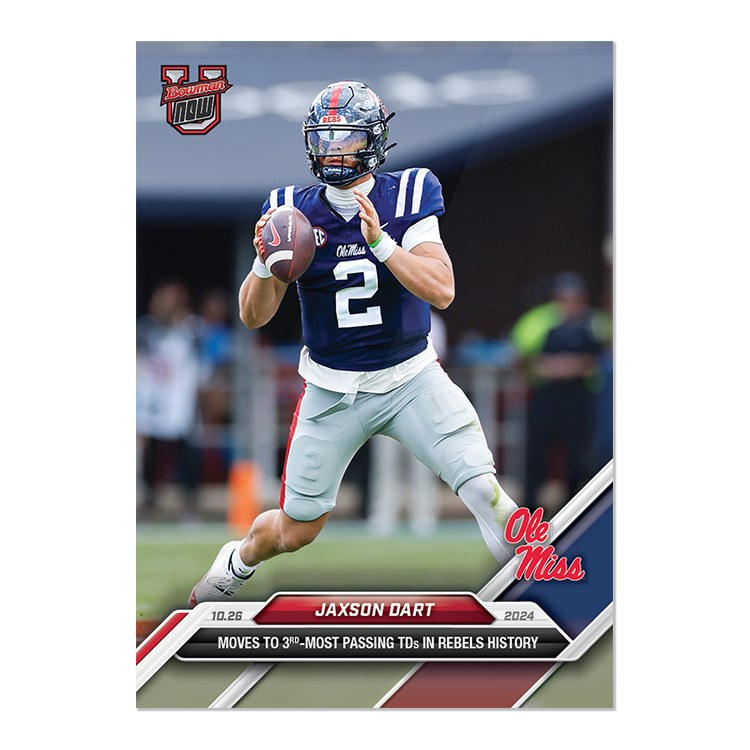
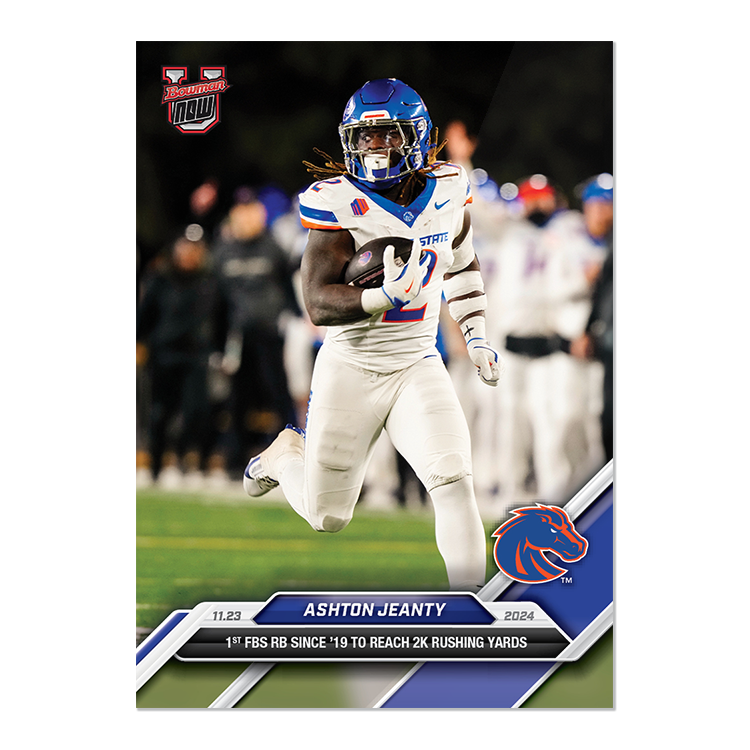
View accessible data
| Player | Date | Release or event | Print run or event | Source |
|---|---|---|---|---|
| Jaxson Dart | 2024-09-10 | 2024 #10 | 690 | Topps |
| Jaxson Dart | 2024-09-24 | 2024 #16 | 985 | Topps |
| Jaxson Dart | 2024-10-29 | 2024 #32 | 307 | Topps |
| Jaxson Dart | 2024-11-04 | 2024 #37 | 523 | Topps |
| Jaxson Dart | 2024-11-12 | 2024 #40 | 339 | Topps |
| Jaxson Dart | 2025-04-24 | Round 1, pick 25, New York Giants | Draft event | Team report |
| Ashton Jeanty | 2024-10-01 | 2024 #20 | 1,446 | Topps |
| Ashton Jeanty | 2024-10-08 | 2024 #22 | 1,991 | Topps |
| Ashton Jeanty | 2024-10-15 | 2024 #24 | 1,874 | Topps |
| Ashton Jeanty | 2024-11-04 | 2024 #34 | 1,990 | Topps |
| Ashton Jeanty | 2024-11-12 | 2024 #38 | 1,042 | Topps |
| Ashton Jeanty | 2024-11-19 | 2024 #43 | 1,414 | Topps |
| Ashton Jeanty | 2024-11-26 | 2024 #48 | 940 | Topps |
| Ashton Jeanty | 2024-12-03 | 2024 #50 | 1,424 | Topps |
| Ashton Jeanty | 2024-12-09 | 2024 #53 | 1,751 | Topps |
| Ashton Jeanty | 2025-04-24 | Round 1, pick 6, Las Vegas Raiders | Draft event | Team report |
Ty Simpson and Jordyn Tyson: the sub-500 exhibit
Simpson's 2025-26 #10 has an official print run of 488. Tyson's #32 has a print run of 473. Both later became first-round selections. Those facts make a striking exhibit because the early supply is so small. They still need to be presented in the order collectors could have learned them.
Simpson's #10 appeared on September 9, 2025. His other verified college cards reached 839 for #22, 533 for #53, and 695 for #61. All four stayed below 1,000. The first three digits did not tell buyers his future draft position. The final print runs themselves also followed the ordering windows.
On April 23, 2026, the Rams selected Simpson at No. 13. His TSIM draft card reached 12,406. We can compare those two offers. We cannot claim that the draft created 25 times as many buyers for #10. We have totals for distinct releases, not a count of people competing for the old card.
Tyson's first verified college entry here is #18 at 605, released September 29, 2025. His #32 followed on October 20 and closed October 23. It printed fewer copies. Six months later, the Saints selected him eighth overall. The JTYS draft card reached 4,539.
For Tyson, the exact close date supports a 182-day gap to selection. For Simpson #10, the exact close was not recovered. We can date its release, but should not invent a closing day. This is a small detail with a large effect on trust. A precise count of days should rest on two verified dates.
What could someone know then? The official card identity, the college moment, and the published offer terms. What happened later? The final print run and the first-round selection became historical facts. The exhibit separates those points. It does not imply that the draft outcome was obvious in September or October.
Nor did selection make every base card expensive. SportsCardsPro reports Simpson base #10 at $3.99 on April 30, 2026. It reports Tyson base #18 at $4 on July 16. Tyson's separate $3 April report concerns a PSA 9, not a raw card. Grade is part of the identity, even when the price seems low. Simpson sales, Tyson sales.
The stronger lesson is about keeping two tests apart. These releases pass the early-scarcity test. Their players later passed the first-round-selection test. A claim about resale success needs another test, with exact-card transactions and costs. A collector should not let the excitement of the first two answers fill in the third.
Under 500, before a first-round selection.
What the card records showed then, and what the team reports confirmed later.
Ty Simpson
2025-26 #10 · Released 2025-09-09
Close: not verified
Final PR followed the buying window.
Selected 2026-04-23
12,406 draft-card orders
First round, not a promised pro career.
View accessible data
| Player | College card | Print run | Release date | Close date | Later event | Draft date | Later card | Sources |
|---|---|---|---|---|---|---|---|---|
| Ty Simpson | 2025-26 #10 | 488 orders | 2025-09-09 | Close: not verified | Round 1, pick 13, Los Angeles Rams | 2026-04-23 | 12,406 draft-card orders | Topps · Team · Topps |
| Jordyn Tyson | 2025-26 #32 | 473 orders | 2025-10-20 | Close: 2025-10-23 | Round 1, pick 8, New Orleans Saints | 2026-04-23 | 4,539 draft-card orders | Topps · Team · Topps |
Fernando Mendoza: attention arrived card by card
Mendoza offers the clearest chance to watch order volume change across a season. It also exposes the danger of sorting numbers into the story we want. His first three verified runs went down: 2,733 for #17, 2,475 for #26, and 1,753 for #33. Their release dates were September 22, October 13, and October 20, 2025.
That is not a staircase. It is a decline across three distinct offers. The smallest of the three came last. Anyone drawing a smooth rise from 1,753 through 2,475 to 2,733 would reverse the dates. The chart below keeps the real order, including every later drop.
Next came #45 at 2,864 and #52 at 2,009. Then #58 reached 4,522. The Heisman release #60 reached 14,052. Mendoza won the award on December 13, 2025, the same date that release opened. The award and the card are linked in time and subject.
The next number complicates the rise again. #64 reached 5,619, well below the Heisman card. Then #66 reached 7,654. Finally, #67 reached 30,616. It opened January 19, 2026, the date of Indiana's national championship win. Larger peaks emerged, but they did not erase the valleys.
There is a separate art release to place correctly. The Chuck Styles FM card reached 17,706. It opened January 20, one day after #67, and shared its January 23 close. It is not an earlier step on the way to 30,616. Its different format and overlapping window make it a separate comparison.
By April, the Raiders selected Mendoza first overall. His FMEN draft release reached 126,581. That is about 72.2 times the 1,753 college #33 run. It is a striking scale change across offers. It is not a measured return on #33 or proof that each draft-card buyer wanted it.
The closing dates add another view. Mendoza #33 closed October 23, 2025. That was 51 days before the Heisman announcement and 182 before his selection. The early window ended before those outcomes. A buyer could not wait for either confirmation and still place a direct order in that window. #33 offer, award record, draft report.
Our inference is that his later cards reflect larger moments drawing more orders. The observed facts are the dates, subjects, and totals. We cannot separate the effects of awards, photographs, premium chases, price, or bulk buying. Even within a single player's story, the offer changes. That is why the full uneven curve teaches more than two carefully chosen endpoints.
Attention arrived in waves.
The first three runs fell. Later peaks grew, with another drop after the Heisman release.
2,733 → 2,475 → 1,753 at the start. The lower early run came later.
Separate art release. January 20, after #67 opened. Not part of this line.
April draft release. A different offer, outside the college timeline.
On mobile, swipe the chart or open “View accessible data” below for all ten releases.
View accessible data
| Release date | Card | Print run | Context | Source |
|---|---|---|---|---|
| 2025-09-22 | #17 | 2,733 | College release | Topps |
| 2025-10-13 | #26 | 2,475 | College release | Topps |
| 2025-10-20 | #33 | 1,753 | College release | Topps |
| 2025-11-17 | #45 | 2,864 | College release | Topps |
| 2025-12-01 | #52 | 2,009 | College release | Topps |
| 2025-12-08 | #58 | 4,522 | College release | Topps |
| 2025-12-13 | #60 | 14,052 | Heisman release | Topps |
| 2026-01-02 | #64 | 5,619 | College release | Topps |
| 2026-01-10 | #66 | 7,654 | College release | Topps |
| 2026-01-19 | #67 | 30,616 | Championship date | Topps |
Omar Cooper Jr.: follow one physical card
Cooper gives this study a different kind of evidence. His 2025-26 #43 printed 1,627. The offer closed November 13, 2025. The Jets selected him thirtieth overall on April 23, 2026, 161 calendar days later. Here we also have two reported prices tied to one numbered, graded copy.
The card is Gold #43, serial 21/50, graded PSA 10. Its certification number is 147785818. PSA's history reports an accepted Best Offer of $200 on March 25, 2026. It reports another at $335 on August 7. The matching certification ties the two reports to the same holder. The public card image confirms the serial. PSA certification and sales history.
The arithmetic is straightforward: $335 less $200 equals $135. Relative to $200, that is a 67.5% gross increase. This is a comparison of reported sale amounts. It excludes fees, shipping, taxes, holding costs, and possible returns. It does not establish the seller's net profit or independently confirm that both payments settled.
The draft occurred between those dates. That makes it relevant context. It does not prove the draft caused the difference. Other events, bidding conditions, and the specific buyers could matter. A same-copy comparison improves card identity. It does not remove every other possible reason for a price change.
There was also a source conflict. A secondary history showed $375 for the August listing. PSA recorded $335 as the accepted offer. We use the reported accepted amount and preserve the disagreement. A displayed asking price can survive in a sale record even when the buyer paid less. PSA's accepted-offer record.
The card number alone would not have been enough. Another July entry on the same PSA page belonged to a different certificate. It does not join this repeat-sale sequence. Serial, grade, certificate, date, and price type all matter when the argument depends on tracking one object. Without those checks, a neat price line could combine unrelated cards.
Cooper's story also continued after the August report. The Jets placed him on injured reserve on September 19, 2026. That event does not tell us his card's current price. It does show why ending every player story at the draft creates a false sense of closure. New risks remain after a first-round selection.
This is useful secondary-market evidence, with clear boundaries. It concerns one premium copy and two PSA-reported transactions. It cannot price every Cooper card. No later Cooper NOW print run was verified for this article. The case connects early supply to a traceable later market observation, while leaving broader demand unresolved. The reported sale details preserve the versions, dates, price types, and source links.
The full cohort, the misses, and the limits of hindsight
The six featured stories were chosen because their records help explain the pattern. They cannot supply a success rate. To keep the smaller names visible, we checked every player release below 500 found in the 2024 and 2025-26 numbered checklists. That produced 24 verified releases covering 20 players. The figure below includes them all, with official card and career links.
Six of those players became first-round picks: Dart, Simpson, Tyson, Tetairoa McMillan, Jeremiyah Love, and Makai Lemon. Together they account for eight releases. Five players account for six later-round releases. Three players went undrafted. Six more were still in college, across seven releases. These counts describe known career paths at September 25, 2026.
The broader checklists contain 124 numbered entries, including non-player subjects. We have primary confirmation for 52 numbered college releases across this research. We do not have equally complete checks for all higher runs. The full checklist review retains every discovered entry and labels what remains unverified. The sub-500 group is the complete checked slice used in this figure, not the entire college-card market.
That boundary prevents several tempting claims. Eight of 24 releases reaching first-round status is not an investment hit rate. One person may have several cards. Selection in the first round does not establish professional success. Neither selection nor a small print run proves strong resale demand. The outcome counted must match the question being asked.
Consider Miller Moss. His #30 printed 192, smaller than either Simpson or Tyson. He later joined the Bears as an undrafted player. That is a clear contrast in draft outcome. It is not evidence that every Moss card stayed cheap. We lack the complete, comparable sale history needed to make that claim.
Antario Brown's #9 printed 498, and he went undrafted in 2025. Diego Pavia's #41 printed 401. He also entered the NFL without being drafted, despite Heisman runner-up attention. These are misses for a first-round-pick screen. They are not proof of absent fans or worthless cards.
Later rounds need their own label. Damien Martinez's #33 printed 402, and he went in round seven. Tez Johnson's #56 printed 343; he also went in round seven. Johnson's team records five receiving touchdowns in 2025. Calling every later-round player a career failure would ignore what happened next. Johnson's game record.
College returners should stay unresolved. The group includes Dante Moore, Jackson Arnold, Josh Hoover, Kevin Jennings, LJ Martin, and DeAndre Moore Jr. Their school records show continued college careers. There is no completed pro outcome to score here. Jennings has two sub-500 releases, which is another reason to count both cards and people. Oregon, UNLV, Indiana, SMU, BYU, Colorado.
For a broader contrast, Xavier Restrepo's #36 printed 736. He later signed as an undrafted free agent. He sits outside the sub-500 count and is labeled separately in the download. Adding him silently would change the selection rule after seeing his outcome.
The clearest low-price evidence actually includes featured first-rounders. Dart, Simpson, Tyson, and Jeanty all have modest base-sale reports discussed above. Missing or private prices remain missing or private, not evidence of zero demand.
This review was assembled after the outcomes. It did not forecast them. That is the central limit of hindsight. The honest use is to build better questions and preserve the next set of answers before events unfold. It is not to claim that today's attractive examples were easy choices then.
Keep the other outcomes in the picture.
All 24 verified sub-500 player releases found in the two numbered checklists. These represent 20 people.
First round
6 players · 8 releases- Jaxson Dart2024 #32: 307 · 2024 #40: 339
- Jeremiyah Love2024 #45: 387
- Jordyn Tyson2025-26 #32: 473
- Makai Lemon2025-26 #28: 466 · 2025-26 #40: 261
- Tetairoa McMillan2024 #47: 247
- Ty Simpson2025-26 #10: 488
Selection is confirmed. Resale success is not.
Later round
5 players · 6 releases- Cade Klubnik2024 #42: 278 · 2024 #57: 238
- Carson Beck2024 #49: 371
- Damien Martinez2024 #33: 402
- Denzel Boston2025-26 #35: 262
- Tez Johnson2024 #56: 343
Later selection is not a failed career.
Undrafted
3 players · 3 releases- Antario Brown2024 #9: 498
- Diego Pavia2025-26 #41: 401
- Miller Moss2025-26 #30: 192
Undrafted does not mean no collector demand.
Still in college
6 players · 7 releases- Dante Moore2025-26 #49: 495
- DeAndre Moore Jr.2025-26 #27: 266
- Jackson Arnold2024 #46: 301
- Josh Hoover2025-26 #16: 366
- Kevin Jennings2025-26 #23: 268 · 2025-26 #38: 235
- LJ Martin2025-26 #51: 446
Do not score an unfinished career as a loss.
View accessible data
| Career path | Player | Release | Print run | Status at review | Sources |
|---|---|---|---|---|---|
| First round | Jaxson Dart | 2024 #32 | 307 | Round 1, pick 25, New York Giants | Topps · Career source |
| First round | Jaxson Dart | 2024 #40 | 339 | Round 1, pick 25, New York Giants | Topps · Career source |
| First round | Jeremiyah Love | 2024 #45 | 387 | Round 1, pick 3, Arizona Cardinals | Topps · Career source |
| First round | Jordyn Tyson | 2025-26 #32 | 473 | Round 1, pick 8, New Orleans Saints | Topps · Career source |
| First round | Makai Lemon | 2025-26 #28 | 466 | Round 1, pick 20, Philadelphia Eagles | Topps · Career source |
| First round | Makai Lemon | 2025-26 #40 | 261 | Round 1, pick 20, Philadelphia Eagles | Topps · Career source |
| First round | Tetairoa McMillan | 2024 #47 | 247 | Round 1, pick 8, Carolina Panthers | Topps · Career source |
| First round | Ty Simpson | 2025-26 #10 | 488 | Round 1, pick 13, Los Angeles Rams | Topps · Career source |
| Later round | Cade Klubnik | 2024 #42 | 278 | Round 4, pick 110, New York Jets | Topps · Career source |
| Later round | Cade Klubnik | 2024 #57 | 238 | Round 4, pick 110, New York Jets | Topps · Career source |
| Later round | Carson Beck | 2024 #49 | 371 | Round 3, pick 65, Arizona Cardinals | Topps · Career source |
| Later round | Damien Martinez | 2024 #33 | 402 | Round 7, pick 223, Seattle Seahawks | Topps · Career source |
| Later round | Denzel Boston | 2025-26 #35 | 262 | Round 2, pick 39, Cleveland Browns | Topps · Career source |
| Later round | Tez Johnson | 2024 #56 | 343 | Round 7, pick 235, Tampa Bay Buccaneers | Topps · Career source |
| Undrafted | Antario Brown | 2024 #9 | 498 | Undrafted in 2025 | Topps · Career source |
| Undrafted | Diego Pavia | 2025-26 #41 | 401 | Ravens confirm Pavia among signed undrafted rookies | Topps · Career source |
| Undrafted | Miller Moss | 2025-26 #30 | 192 | Bears sign Moss as undrafted free agent | Topps · Career source |
| Still in college | Dante Moore | 2025-26 #49 | 495 | Oregon reports Moore will return in 2026 | Topps · Career source |
| Still in college | DeAndre Moore Jr. | 2025-26 #27 | 266 | Colorado lists Moore on its 2026 roster after Texas transfer | Topps · Career source |
| Still in college | Jackson Arnold | 2024 #46 | 301 | UNLV reports Arnold participating after transfer from Auburn | Topps · Career source |
| Still in college | Josh Hoover | 2025-26 #16 | 366 | Indiana identifies Hoover as its starting quarterback after TCU transfer | Topps · Career source |
| Still in college | Kevin Jennings | 2025-26 #23 | 268 | Returning SMU quarterback receives school Heisman campaign | Topps · Career source |
| Still in college | Kevin Jennings | 2025-26 #38 | 235 | Returning SMU quarterback receives school Heisman campaign | Topps · Career source |
| Still in college | LJ Martin | 2025-26 #51 | 446 | BYU returning senior receives Big 12 preseason offensive player award | Topps · Career source |
Why the 90 or 91-card hit structure matters
Small print runs change more than the number of ordinary cards tied to a release. They can also change the amount of announced numbered inventory relative to orders. Dart #32 lists /49, /25, /10, /5, and 1/1. Those tiers total 90. Simpson #10 and Tyson #32 list a /50 top tier instead. Their standard totals are 91. Dart, Simpson, Tyson.
For Dart #32, divide 90 by 307. The result is about 29.32%. For Simpson, 91 divided by 488 is about 18.65%. For Tyson, 91 divided by 473 is about 19.24%. These are standard-foil inventory shares relative to reported print run. They are not promises about what a buyer received.
Expected counts take one further step. Multiply the share by the number of eligible ordered units. For Dart #32, ten times 90 divided by 307 is about 2.932. Under the stated assumptions, that is the expected number of standard foils for ten units. No parcel contains 0.932 of a card. The decimal describes a long-run average under a model.
The assumptions matter. Every announced foil must be allocated across the eligible ordered units. The calculation assumes uniform allocation. We use the published print run as the order reference. We do not assert that it equals a count of physical base cards where replacement terms apply. This is a conditional expected count, not the probability of receiving at least one hit.
The figure gives the same calculation for one, five, ten, and twenty units. It includes Moss #30 at 192. Its 91 standard foils produce a 47.40% inventory share. That is the highest shown here, beside an undrafted player. Dense numbered inventory and a successful future football story are separate things. Moss product, career record.
Premium inventory needs a separate count. Cooper #43 lists 91 standard foils and sixteen autograph redemptions. Against its 1,627 print run, ten units imply about 0.559 standard foils and 0.098 autograph redemptions. Their combined known expected count is about 0.658. The autograph expectation does not include the standard foils a second time. Cooper's offer.
Unknown versions stay outside known totals. Mendoza #33 advertises an image variation without a recovered quantity. We count its stated standard foils, but cannot calculate the complete hit total. Jeanty #43 has a known premium subtotal and an unknown standard ladder in the captured offer. Neither unknown becomes zero. Mendoza #33, Jeanty #43.
Later pro offers may add still more layers. Mendoza's 126,581-run draft card qualified for 190 additional Chrome parallels. Its 91 standard foils and sixteen autograph hits bring known numbered inventory to 297. The Chrome layer remains separate from the ordinary foil ladder. FMEN terms. The hit-structure history explains why season and product matter.
Do not apply a blanket 90-card rule to current Bowman U NOW. The four 2026-27 offers reviewed here use 91 standard foils. Underwood #6 is one example. For comparisons with professional programs using 91, 41, or sixteen foils, use the PrintRun chase study. Count the exact target first. A denser chase still cannot answer what the card will sell for.
A small run can hold a dense foil pool.
Standard numbered foils only. High density also appears beside an undrafted player.
Miller Moss #30
4.74Jaxson Dart #32
2.932Jaxson Dart #40
2.655Jordyn Tyson #32
1.924Ty Simpson #10
1.865Ashton Jeanty #48
0.957Omar Cooper Jr. #43
0.559Moss leads this selected comparison. He went undrafted. A dense chase cannot establish future demand.
View accessible data
| Release | Official PR | Standard foils | Foils / PR | Expected per 1 | Per 5 | Per 10 | Per 20 | Source |
|---|---|---|---|---|---|---|---|---|
| Miller Moss #30 | 192 | 91 | 47.40% | 0.474 | 2.370 | 4.740 | 9.479 | Topps |
| Jaxson Dart #32 | 307 | 90 | 29.32% | 0.293 | 1.466 | 2.932 | 5.863 | Topps |
| Jaxson Dart #40 | 339 | 90 | 26.55% | 0.265 | 1.327 | 2.655 | 5.310 | Topps |
| Jordyn Tyson #32 | 473 | 91 | 19.24% | 0.192 | 0.962 | 1.924 | 3.848 | Topps |
| Ty Simpson #10 | 488 | 91 | 18.65% | 0.186 | 0.932 | 1.865 | 3.730 | Topps |
| Ashton Jeanty #48 | 940 | 90 | 9.57% | 0.096 | 0.479 | 0.957 | 1.915 | Topps |
| Omar Cooper Jr. #43 | 1627 | 91 | 5.59% | 0.056 | 0.280 | 0.559 | 1.119 | Topps |
A pre-draft attention research screen
The practical result is a research screen, not a shopping list. Start with one exact release. Write down the player, season, program, card number, and official source. Keep the image beside those facts. If the product identity conflicts, stop that comparison until the conflict is resolved. Jeanty's disputed #5 shows why a familiar-looking address is not enough.
Next, record what is actually known about supply. Is the buying window still open? Is the print run final? How many other cards already show the player? What standard tiers are listed? Are autographs inserted or sold separately? Which quantities remain unknown? A guessed total can make a precise-looking calculation useless.
Then date the next plausible football event. Draft eligibility matters before draft position. Age and remaining eligibility help explain the timeline. A starting role, an award race, a conference game, or a confirmed selection may offer a reason to review the case. A vague belief that more people will notice is not a dated event.
Assess the football case without pretending to scout from one highlight. Record the starting role and the direction of performance. Read credible draft coverage and preserve its range of outcomes. Note the position and school audience. Include injury and transfer risk. Those are questions to investigate, not inputs to a score that guarantees collector demand.
The market check comes separately. Match the exact card, version, serial, and grade. Look for a completed date and a public accepted price. Save the source link. An active asking price belongs in a different column. If only premium cards have sales, do not use them to price the base. Cooper's repeat-sale example shows the level of identity needed.
Write the weak case before the strong one. What happens if the player stays in college? What happens if the draft result is later than expected? What if attention moves to a newer card? Could the card still belong in your collection? These questions connect uncertain football outcomes to the actual purchase you are considering.
Set a cost and quantity boundary before buying. Include delivery and any planned grading or selling costs. Decide what you could accept losing if a resale buyer never appears. This article supplies no estimate of that loss for a current player. The guide to Topps NOW value separates collecting enjoyment, chase value, and resale plans.
Finally, preserve the date of your view and review it later. Keep the players that disappointed beside the ones that worked. Keep unresolved cases open. Use the same rules each time. Without that record, a screen can quietly become a scrapbook of successes. Our historical sample is useful precisely because it shows how much remains unknown.
A useful PrintRun research view could bring these facts together: verified low runs, stated hit counts, public career events, and review dates. The framework below makes no claim that such a forecast has been proved. Its value is simpler. It makes the collector explain the supply, the possible next event, and the evidence still missing.
Research the gap before choosing a card.
Use the same questions for every player. Save the answer while the future is still uncertain.
- 01
Identify the card
Season, program, number, image and official link
Pause if: A similar name or a guessed product identity.
- 02
Measure the supply
Final PR, other releases, foil tiers and separate premiums
Pause if: A forecast treated as a final count; unknown quantities filled with zero.
- 03
Date the next event
Eligibility, draft range, likely role and public event dates
Pause if: A vague claim that wider attention is certain.
- 04
Test the football case
Age, role, production, school reach, injury and transfer risk
Pause if: A highlight used as the entire case.
- 05
Check the market
Exact version, serial, grade, sold date and accepted price
Pause if: An asking price or another card used as a sale.
- 06
Set the boundary
Delivered cost, quantity, acceptable loss and review date
Pause if: A purchase that only works if prices rise.
View accessible data
| Check | Record | Reason to pause |
|---|---|---|
| Identify the card | Season, program, number, image and official link | A similar name or a guessed product identity. |
| Measure the supply | Final PR, other releases, foil tiers and separate premiums | A forecast treated as a final count; unknown quantities filled with zero. |
| Date the next event | Eligibility, draft range, likely role and public event dates | A vague claim that wider attention is certain. |
| Test the football case | Age, role, production, school reach, injury and transfer risk | A highlight used as the entire case. |
| Check the market | Exact version, serial, grade, sold date and accepted price | An asking price or another card used as a sale. |
| Set the boundary | Delivered cost, quantity, acceptable loss and review date | A purchase that only works if prices rise. |
Supply closes before the story does
The recurring pattern is now visible across different kinds of stories. Dart had several small college releases before an NFL career. Jeanty had modest card totals despite a major college profile. Simpson and Tyson had verified sub-500 releases before first-round selections. Mendoza's sequence captured much larger late peaks without rising in a straight line.
Cooper adds a traceable market observation, but only for one premium copy. The wider group adds later-round picks, undrafted players, and unfinished college stories. Cheap reported base sales remain beside the famous names. Together, these records keep the thesis from becoming a promise it cannot support. The facts and links above are the limits of the case.
Scarcity is often created before certainty. In this program, the small order total can be fixed before the football outcome becomes clear. Waiting may bring better information about the player. It cannot bring back the earlier direct-order window. That timing is the point worth carrying into the next piece of research.
It is not a reason to buy every small run. It is a reason to notice the difference between a known supply and an unknown future. Check the exact offer. Look for real sales. Keep the misses. Decide what makes the card worth owning before a later story makes the earlier choice look easy.
The supply closes before the story does.